
You looked at the clock five minutes ago.
Or at least it feels like five minutes.
Then you glance back up and somehow it’s been 47 minutes.
The coffee you made is cold.
You forgot to answer the text.
You missed your meeting.
Now you’re wondering:
“How does this keep happening?”
If you have ADHD, autism, or both (AuDHD), this experience may have very little to do with motivation, intelligence, or caring enough.
It may be something called time blindness, a common but often misunderstood aspect of neurodivergence that affects how your brain experiences the passage of time.
Understanding time blindness can replace years of shame with something much more helpful: context.
What Is Time Blindness?
Time blindness refers to difficulty accurately sensing, estimating, and managing the passage of time.
Rather than feeling like a steady stream, time may feel like it exists in only two categories:
- Now
- Not Now
This means your brain may struggle to naturally keep track of:
- how long something has taken
- how long something will take
- how much time remains
- when to begin preparing
- how quickly time is passing
This isn’t because you aren’t trying.
It’s because your internal sense of time functions differently.
What Time Blindness Actually Feels Like
People often describe experiences like:
- “I swear I just sat down.”
- “I’ll leave in five minutes.”
- “Where did my entire afternoon go?”
- “I know my appointment is today…but it doesn’t feel real.”
- “I thought I had plenty of time.”
- “Everything feels either urgent or infinitely far away.”
Instead of experiencing time continuously, it can feel surprisingly invisible until it suddenly becomes an emergency.
Why Does Time Blindness Happen?
Time perception relies on several brain systems working together.
These include:
- executive functioning
- working memory
- attention regulation
- planning
- task switching
- prospective memory (remembering to remember)
Many neurodivergent people experience differences in these systems.
Rather than your brain constantly monitoring time in the background, it may devote its attention almost entirely to whatever currently has your focus.
Once attention shifts away from the clock, your awareness of time often disappears with it.
Time Blindness in ADHD vs. Autism
Time blindness is one of the most commonly discussed experiences among adults with ADHD. However, time blindness is also present in Autistic adults. The table below shows how it presents in both.
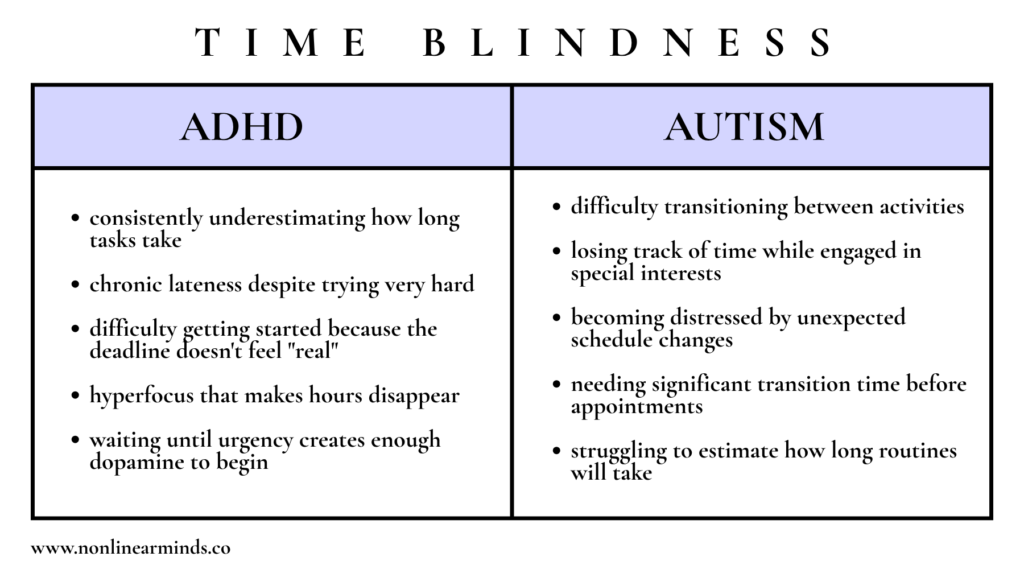
What About AuDHD?
People with both ADHD and autism often experience both patterns simultaneously.
For example:
You may hyperfocus for hours…
…while also needing extensive preparation before leaving the house.
You may forget appointments…
…yet become highly distressed when schedules unexpectedly change.
This combination can make time feel especially confusing and exhausting.
Signs You May Experience Time Blindness
You might notice yourself:
- always running a few minutes late
- arriving extremely early because you’re afraid of being late
- constantly underestimating tasks
- procrastinating until the deadline feels immediate
- forgetting appointments unless reminded repeatedly
- feeling surprised by how quickly evenings disappear
- skipping meals because you lost track of time
- staying awake much later than intended
- struggling to stop activities once you’ve started
- feeling like your entire day disappeared without accomplishing what mattered
You don’t need every sign for time blindness to be affecting your life.
Time Blindness Is Not Laziness
This is one of the biggest misconceptions.
People often assume that if someone is late, procrastinates, or forgets deadlines, they simply don’t care enough.
But many neurodivergent adults care deeply.
They often:
- set multiple alarms
- write detailed planners
- buy calendars
- create color-coded systems
- stay anxious about forgetting
Despite enormous effort, those strategies sometimes still fail.
When people repeatedly receive messages that they’re irresponsible, lazy, careless, or immature, shame often becomes layered on top of executive functioning differences.
Over time, this can contribute to chronic stress, burnout, and self-doubt.
How Anxiety Can Make Time Blindness Worse
Many neurodivergent adults eventually become so anxious about forgetting something that they begin constantly monitoring time.
Ironically, this often creates even more stress.
Some people become:
- afraid to start enjoyable activities
- unable to relax before appointments
- constantly checking clocks
- mentally rehearsing upcoming obligations
This experience is sometimes called waiting mode, where it feels impossible to fully engage in anything before an upcoming event.
If you’ve spent years wondering why everyone else seems to effortlessly “keep track of time” while your days seem to disappear, you’re not alone.
Time blindness isn’t about laziness, carelessness, or a lack of motivation. It’s one way that many neurodivergent brains experience the world differently. When you understand what’s happening, it’s easier to replace self-criticism with curiosity—and to start building systems that work with your brain instead of against it.
Understanding time blindness is only the beginning. The next step isn’t trying harder; it’s learning how to make time more visible, reduce unnecessary friction, and create supports that fit the way your mind naturally works.
What is time blindness?
Time blindness is a difficulty accurately perceiving and managing the passage of time. Many people with ADHD, autism, and AuDHD struggle to estimate how long tasks will take, notice time passing, or prepare for upcoming events. While time blindness isn’t a medical diagnosis, it’s a commonly recognized experience related to differences in executive functioning.
Is time blindness a symptom of ADHD?
Time blindness is not listed as an official symptom of ADHD in diagnostic criteria, but it is a very common experience among people with ADHD. Difficulties with executive functioning, working memory, attention regulation, and planning can make it challenging to keep track of time or estimate how long activities will take.
Can autistic people also experience time blindness?
Yes. Although time blindness is often associated with ADHD, many autistic people also experience differences in time perception. This may show up as difficulty transitioning between activities, losing track of time during focused interests, or needing extra time to prepare for changes in routine.