
You know you’re overwhelmed. Your brain rarely seems to slow down. You overthink conversations, procrastinate on things you know you need to do, struggle to focus, and somehow feel simultaneously exhausted and unable to relax.
So…is it anxiety?
Maybe.
But for many women who discover they have ADHD in adulthood, anxiety was the explanation they received first.
ADHD and anxiety can look surprisingly similar from the outside. Both can affect concentration, memory, sleep, motivation, and your ability to get things done. They also commonly occur together, which can make figuring out what is actually happening even more complicated.
The difference often becomes clearer when we look beyond what you’re struggling with and start asking why it’s happening.
Why ADHD Can Look Like Anxiety in Women
When people picture ADHD, they may still imagine someone who is visibly hyperactive, impulsive, disruptive, or unable to sit still. That isn’t how ADHD always presents.
For many women, ADHD can be much less visible. You might have spent years developing ways to compensate for difficulties with attention, working memory, organization, time management, or task initiation.
⟡ Maybe you became a perfectionist.
⟡ Maybe you learned that waiting until the last minute gave your brain enough urgency to finally get started.
⟡Maybe you write down everything because you know you’ll forget otherwise.
⟡ Maybe you obsessively check your calendar because you’ve missed something important before.
⟡ Maybe you’re constantly worried about disappointing people because you’ve forgotten texts, appointments, deadlines, or things you genuinely intended to do.
Eventually, anxiety can become part of the system that keeps everything functioning. From the outside, it may look like you’re organized and successful.Internally, you may feel like you’re constantly trying to prevent everything from falling apart.
ADHD vs. Anxiety: The Same Symptom Can Have Different Causes
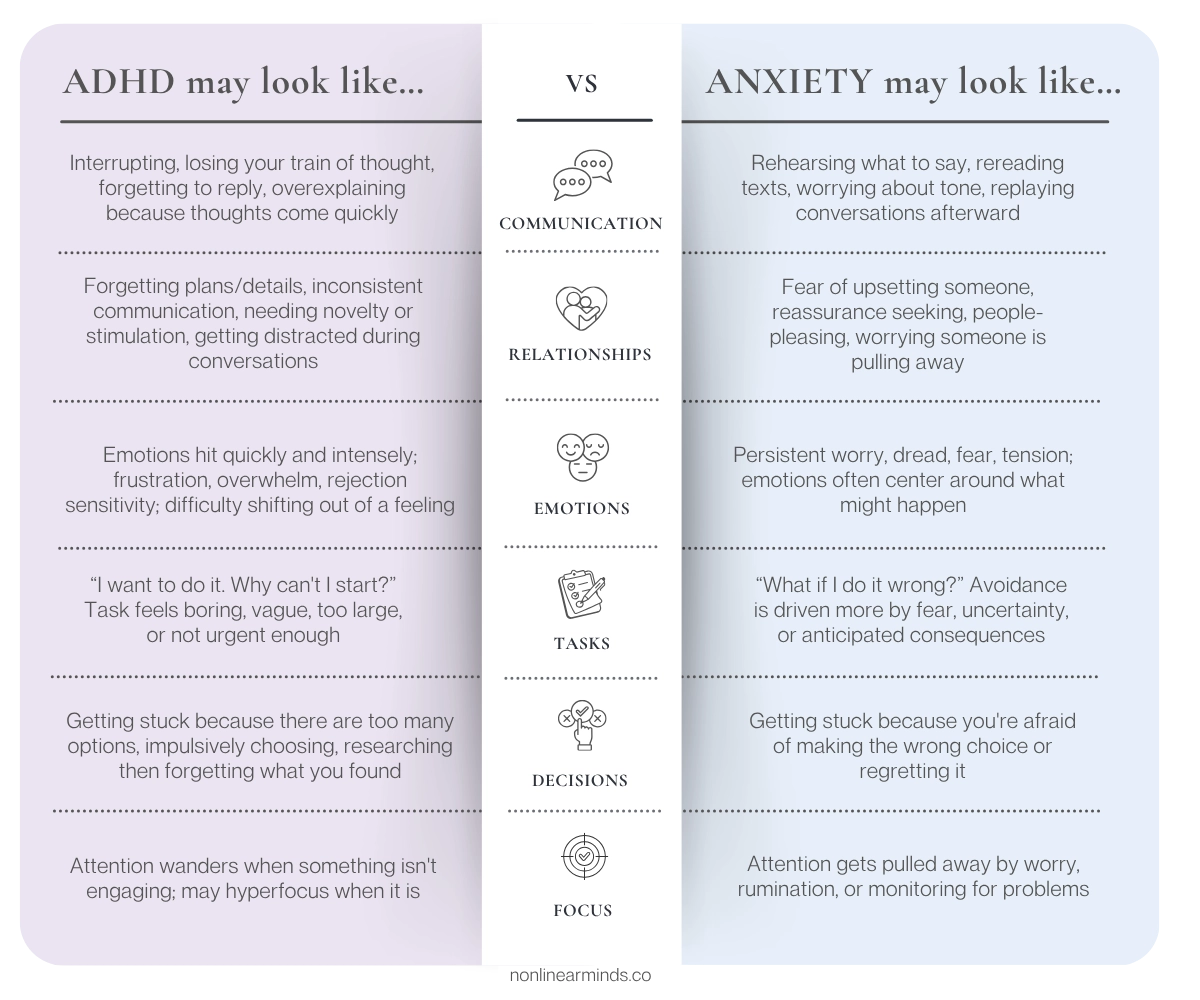
One reason ADHD and anxiety can be difficult to distinguish is that they can produce some of the same experiences.
Take difficulty concentrating.
Someone experiencing anxiety might struggle to focus because their attention is consumed by worry:
What if I mess this up? What if something goes wrong? What if they think I’m incompetent?
Someone with ADHD might struggle to focus because their brain isn’t sufficiently engaged by the task. Their attention drifts, they start thinking about something unrelated, notice something in the room, open another tab, or suddenly realize they’ve read the same paragraph four times.
The outcome is the same:
I can’t focus.
But what’s happening underneath can be very different.
The same is true for procrastination.
Anxiety might cause you to avoid a task because you’re afraid of doing it incorrectly.
ADHD might make it difficult to initiate the task even when you aren’t particularly afraid of it.
And sometimes?
It’s both.
You have trouble starting the task, you’ve had years of experiences where things took longer than expected or didn’t go according to plan, and now you’re anxious about the task because you’ve learned not to trust your ability to get it done.
That’s where things can get complicated.
Signs Anxiety May Be Driving the Difficulty
Anxiety tends to involve fear, worry, or anticipation of something going wrong.
You may notice:
- Your thoughts frequently revolve around possible negative outcomes.
- You avoid situations because you’re worried about what might happen.
- You have difficulty concentrating because your mind is occupied by worry.
- You repeatedly seek reassurance that things are okay.
- You replay interactions and wonder whether you said or did something wrong.
- You experience physical tension, restlessness, or a sense of being on edge.
- You feel a strong need to prevent mistakes or maintain control.
- Your difficulty starting tasks is often connected to fear of failure, judgment, or making the wrong decision.
Anxiety can also create executive-function difficulties of its own. When your brain is devoting significant energy to monitoring potential threats, planning, remembering, concentrating, and making decisions can become much harder.
Signs ADHD May Be Part of The Picture
ADHD difficulties tend to show up across situations and aren’t always connected to worry.
You might notice patterns like:
- You struggle to begin tasks even when you aren’t anxious about them.
- You frequently underestimate how long things will take.
- You lose track of time when you’re absorbed in something.
- You forget what you were doing halfway through doing it.
- You regularly misplace everyday items.
- You have difficulty following multi-step verbal instructions.
- You procrastinate until a deadline creates enough urgency to get moving.
- You can focus intensely on interesting things but struggle to sustain attention on routine tasks.
- You have dozens of systems, planners, apps, alarms, or reminders—but still struggle to consistently use them.
- Small administrative tasks can feel disproportionately difficult.
- Your brain feels busy even when you aren’t worried about anything in particular.
Another important clue is history.
ADHD is a neurodevelopmental condition, meaning the underlying pattern begins in childhood—even if nobody recognized it at the time. That doesn’t necessarily mean you were failing classes or getting in trouble.
Childhood ADHD can look like losing homework, forgetting permission slips, daydreaming, messy backpacks, constantly rushing in the morning, struggling with multi-step instructions, procrastinating on projects, or relying on parents and teachers to provide structure.
Sometimes those difficulties don’t become obvious until adulthood removes much of that external structure.
“But I Did Well in School.”
Doing well academically does not automatically rule out ADHD. Grades tell us how you performed. They don’t necessarily tell us what it took for you to perform that way.
You might have earned good grades while:
- Doing assignments at the last possible minute.
- Spending significantly longer on schoolwork than your peers.
- Relying on anxiety about failure to motivate yourself.
- Hyperfocusing on subjects you enjoyed and struggling through everything else.
- Forgetting assignments but finding ways to recover.
- Having a parent who kept track of schedules, paperwork, appointments, and deadlines.
- Being highly perfectionistic.
- Experiencing significant exhaustion from keeping up.
For some people, the transition to college, graduate school, a demanding career, parenthood, living independently, or another major life change is when previously effective coping strategies stop being enough.
Suddenly, what looked manageable becomes overwhelming.
What If Anxiety Is Actually Helping You Compensate for ADHD?
This is one of the more confusing possibilities. Sometimes anxiety isn’t simply occurring alongside ADHD. It may have become a compensation strategy.
If you’ve learned that your memory is unreliable, you might repeatedly check things.
If you’ve missed deadlines before, you might become intensely anxious about being late.
If you’ve forgotten appointments, you might check your calendar ten times.
If you have difficulty estimating time, you might become extremely early for everything because being late feels intolerable.
If you’ve been criticized for seeming careless, forgetful, messy, or inconsistent, you might develop perfectionistic standards designed to prevent anyone from seeing you struggle.
In other words, some of the behaviors that make you appear highly organized may exist because organization doesn’t come automatically. That distinction can be incredibly important during an ADHD assessment.
Can You Have ADHD and Anxiety at the Same Time?
Absolutely.
ADHD and anxiety aren’t mutually exclusive.



In fact, years of struggling with undiagnosed ADHD can create plenty of experiences worth becoming anxious about.
Repeatedly forgetting things, running late, missing details, struggling to meet expectations, feeling inconsistent, or being told you’re “not living up to your potential” can affect how much you trust yourself. You may begin anticipating failure before you’ve even started.
So the question isn’t always:
“Is this ADHD or anxiety?”
Sometimes the more useful question is:
“How are ADHD and anxiety interacting with each other?”
What About Perfectionism?
Perfectionism can make the picture even harder to recognize. A person with ADHD isn’t necessarily someone who doesn’t care about details. Sometimes it’s exactly the opposite.
You may care so much about getting things right that you spend excessive amounts of time checking, revising, researching, preparing, or trying to create the perfect system before you begin. Perfectionism can become a way of compensating for feeling internally inconsistent.
And because you’re technically “getting things done,” other people may never realize how much effort it requires.
That’s why looking only at outward functioning can miss important parts of someone’s experience.
“I’m Too Organized to Have ADHD.”
Maybe you’re the person with twelve alarms.
Three calendars. Color-coded reminders. A note on the door so you don’t forget the thing sitting directly beside the note.
That doesn’t necessarily mean organization comes easily to you. Sometimes the better question is:
What happens when the systems aren’t there?
During an ADHD assessment, it’s important to look not only at whether someone can function, but also at the amount of structure, effort, stress, and compensation required to maintain that functioning.
How Do Clinicians Tell ADHD and Anxiety Apart?
There isn’t one questionnaire that can perfectly answer the question. A thoughtful assessment looks at the larger pattern.
That may include:
- Your current difficulties.
- Your childhood experiences.
- When symptoms began.
- Where difficulties show up.
- What makes them better or worse.
- The strategies you’ve developed to compensate.
- How much effort everyday functioning requires.
- Whether anxiety explains the difficulties, or whether something remains even when anxiety is relatively low.
- Other possibilities that could better explain your experiences.
- Whether ADHD and anxiety may both be present.
This is also why an assessment shouldn’t simply be about accumulating enough symptoms to earn a diagnosis. The goal is to understand how your brain actually functions in everyday life.
You Don’t Have to Be Sure It’s ADHD Before Seeking an Assessment
A common misconception is that you should only pursue an ADHD assessment once you’re fairly certain you have ADHD.
You don’t need to know. That’s the point of an assessment.
You might come in thinking it’s ADHD and discover anxiety is playing a much larger role than you realized. You might have spent years assuming everything was anxiety and discover ADHD helps explain patterns that anxiety never fully accounted for. You might discover that both are contributing.
Or the assessment might point toward something else entirely. A useful evaluation isn’t about proving that you have ADHD.
It’s about developing a clearer understanding of what’s happening, and what might actually help.
Adult ADHD Assessments in Florida
If you’ve spent years wondering why things seem harder than they “should” be, an assessment can offer an opportunity to look at the whole picture rather than another isolated list of symptoms.
At Nonlinear Minds Therapy, adult ADHD and autism assessments are designed to explore not only diagnostic criteria, but also your lived experience—including executive functioning, masking, compensation strategies, developmental history, and the ways you’ve learned to navigate everyday demands.
Adult ADHD assessments are available in Fort Lauderdale and via telehealth throughout Florida.
Wondering whether what you’re experiencing could be ADHD, anxiety, or both?
Frequently Asked Questions About ADHD and Anxiety
Can ADHD be mistaken for anxiety in adults?
Yes. ADHD and anxiety can share several experiences, including difficulty concentrating, restlessness, procrastination, overwhelm, sleep difficulties, and trouble completing tasks. In some adults, particularly women whose ADHD was not recognized earlier in life, anxiety may be identified before ADHD is considered.
One helpful distinction is why something is happening. Difficulty concentrating because your attention frequently shifts or a task isn’t engaging can look different from difficulty concentrating because your mind is occupied by worry. A comprehensive assessment looks at these patterns in context rather than relying on one symptom alone.
How do I know if I have ADHD or anxiety?
There isn’t a single symptom or online quiz that can reliably distinguish ADHD from anxiety. Clinicians typically consider when your difficulties began, whether they occur even when you aren’t anxious, your childhood and developmental history, how symptoms appear across different areas of your life, and what may be driving them.
It’s also possible to have both ADHD and an anxiety disorder, so the answer isn’t always one or the other.
Can anxiety cause ADHD-like symptoms?
Yes. Anxiety can affect concentration, memory, decision-making, task initiation, sleep, and executive functioning. When much of your mental energy is devoted to worrying or anticipating potential problems, it can be harder to focus and organize your thoughts.
However, ADHD is a neurodevelopmental condition with patterns that begin in childhood. Understanding your history can therefore be an important part of distinguishing between the two.
Can untreated ADHD cause anxiety?
Living with unrecognized or unsupported ADHD can contribute to anxiety for some people. Repeated experiences of forgetting important things, running late, missing details, struggling with deadlines, or feeling unable to consistently meet expectations can make you start anticipating that something will go wrong.
Over time, anxiety, perfectionism, excessive checking, or overpreparing can sometimes develop as ways of compensating for ADHD-related difficulties.
Can I have both ADHD and anxiety?
Yes. ADHD and anxiety can occur together, and one can make the other more difficult to manage. Anxiety can place additional demands on attention and executive functioning, while ADHD-related difficulties can create experiences that contribute to worry and self-doubt.
An assessment can help identify how these patterns interact rather than assuming every difficulty comes from one diagnosis.
Why is ADHD sometimes missed in women?
ADHD doesn’t always look like the stereotypical picture of obvious hyperactivity or disruptive behavior. Some women develop strong compensatory strategies, perform well academically, internalize their difficulties, or experience symptoms that are interpreted as anxiety, perfectionism, stress, or overwhelm.
Looking beyond outward functioning to the amount of effort required to maintain it can reveal patterns that may otherwise be overlooked.
Can you have ADHD if you are organized and successful?
Yes. Being organized, successful, or academically accomplished does not automatically rule out ADHD. Some adults maintain a high level of functioning through extensive systems, reminders, routines, perfectionism, deadline pressure, or significant amounts of effort.
A useful question isn’t only “Can you do it?” but also “What does it take for you to do it consistently?”
Should I get an ADHD assessment if I already have anxiety?
If anxiety explains some of your experiences but doesn’t seem to explain the whole picture, an ADHD assessment may be worth considering. This may be especially relevant if difficulties with attention, organization, time management, forgetfulness, impulsivity, or task initiation have been present since childhood or continue even during periods when your anxiety is relatively manageable.
You don’t need to be certain you have ADHD before seeking an assessment. Part of the assessment process is exploring alternative explanations and understanding what best accounts for your experiences.
Can an adult ADHD assessment be done online in Florida?
Adult ADHD assessments may be offered through telehealth when clinically appropriate. Nonlinear Minds Therapy provides adult ADHD and autism assessment services through telehealth for adults located throughout Florida.
ⓘ This article is for educational purposes and is not intended to diagnose ADHD, anxiety, or any other mental health condition.