
When overthinking, perfectionism, procrastination, checking, intrusive thoughts, and getting “stuck” could point to ADHD, OCD, or both.
Maybe you reread an email five times before sending it. Maybe you walk back to make sure you locked the door—even though you’re pretty sure you did. Maybe one awkward interaction can occupy your brain for the rest of the day. Or you spend so much time trying to figure out the right way to do something that you never actually start.
These experiences can happen with ADHD. They can happen with OCD. They can happen with anxiety, trauma, or a handful of other things. And sometimes, more than one thing is happening at the same time. That’s part of what makes ADHD and OCD surprisingly difficult to untangle.
From the outside, two people can be doing the exact same thing for completely different reasons.
The question usually isn’t just:
“What am I doing?”
It’s also:
“What is my brain trying to accomplish by doing it?”
ADHD and OCD Can Look Surprisingly Similar
ADHD and OCD are different conditions, but real life doesn’t always separate itself neatly into diagnostic categories.
✦ Getting stuck on thoughts.
Your brain keeps returning to something even when you’d really like to move on.
✦ Procrastinating or avoiding things.
You know you need to do something. You may even desperately want to do it. Somehow, you’re still not doing it.
✦ Difficulty with uncertainty.
Not knowing can feel much more uncomfortable than it seems like it “should.”
✦ Repetition and routines.
Doing something a particular way may make life feel easier, safer, more predictable, or simply possible.
✦ Checking things repeatedly.
The door. The stove. The email you just sent. Your calendar. The instructions you already read.
✦ Perfectionism.
A simple task becomes much bigger because making a mistake feels unusually difficult.
✦ Reassurance seeking.
“Are you sure?”
“Did I do this right?”
“Are you mad at me?”
“Do you think this is okay?”
✦ Thoughts that won’t leave you alone.
Sometimes it’s overthinking. Sometimes it’s rumination. Sometimes it’s an intrusive thought. Sometimes it’s hyperfocus. Sometimes it’s an obsession.
Same Behavior. Different Reason
This is one of the most useful ways to start understanding ADHD and OCD.
Imagine two people who both check the front door three times before leaving the house.
Person A
“I was thinking about six other things when I locked it, so I genuinely don’t remember whether I actually did.”
Checking gives them information they don’t trust their memory to provide.
Person B
“I remember locking it. But what if it didn’t latch all the way? What if someone gets in? What if something happens because I didn’t check?”
Checking gives them temporary relief from uncertainty and fear.
From the sidewalk? They look identical. Both people walked back and checked the door. But internally, very different things may be happening. And that’s why comparing ADHD and OCD based only on observable symptoms can get messy very quickly.
Think Function, Not Just Behavior
Instead of asking:
“Do people with ADHD check things?”
or:
“Do people with OCD procrastinate?”
A more useful set of questions might be:
✦ What happened immediately before I did this?
✦ What feeling, thought, urge, or problem was I responding to?
✦ What was I hoping would happen when I did it?
✦ What happens if I don’t do it?
✦ And what do I feel immediately afterward?
That last question can be especially revealing.
Sometimes a behavior helps someone compensate for an executive-function difficulty. Sometimes it helps regulate attention or stimulation. Sometimes it temporarily reduces anxiety. Sometimes it creates a feeling of certainty. Sometimes it neutralizes a frightening thought. Sometimes it’s a strategy someone developed after years of mistakes, criticism, or feeling like they couldn’t trust themselves.
And sometimes?
It’s several of those things at once.
Same Behavior, Different Brain Logic
Same Behavior. Different Brain Logic.
Choose something you notice yourself doing. Then look at what might be happening underneath it.
Same behavior
Checking something more than once
“I genuinely don’t remember if I did it.”
The second check may be an attempt to compensate for attention or working-memory uncertainty.
“I remember doing it—but what if I didn’t do it correctly?”
The second check may be an attempt to reduce distress, doubt, or uncertainty—even when the person already has the information.
Am I checking because I don’t trust my memory—or because I can’t feel certain enough?
These examples describe possible patterns, not rules. ADHD can involve anxiety and difficulty tolerating uncertainty. OCD can involve attention and memory difficulties. Anxiety, trauma, autism, depression, and other experiences can shape the same behaviors—and ADHD and OCD can occur together. The goal is to get curious about what the behavior is doing for you, not sort yourself into a box.
But What Does It Feel Like From the Inside?
Two people can describe the same experience: “I can’t stop thinking about it”, and be talking about very different things.
That’s where words like overthinking, rumination, intrusive thoughts, hyperfocus, and obsessions can get confusing. They’re often used interchangeably online, but they don’t necessarily describe the same process.
Instead of focusing only on what the thought is about, it can help to notice how the thought shows up, what keeps pulling you back to it, and what your brain seems to be asking you to do about it.
“I Can’t Stop Thinking About It”
Maybe you replayed a conversation all the way home. Then again while you were making dinner. Then you remembered something else you said and started analyzing that. Or maybe a thought appeared completely out of nowhere:
What if I hurt someone?
What if I secretly meant something terrible?
What if I made a mistake and just haven’t realized it yet?
Or maybe you’ve discovered something fascinating and suddenly it’s 2 a.m., you have 37 tabs open, and you’ve somehow become temporarily qualified to give a TED Talk about Victorian mourning jewelry.
All of these experiences can feel like:
Why can’t my brain just let this go?
But what’s keeping the thought alive may be very different.
ADHD: When Attention Keeps Getting Pulled Back
ADHD isn’t simply an inability to pay attention. It involves difficulty regulating attention. Sometimes that means struggling to stay with something your brain finds understimulating. Other times, it means struggling to disengage from something your brain has decided is extremely interesting, stimulating, emotionally significant, novel, or unresolved.
You might notice:
I know I need to move on, but my brain keeps going back to it.
The thought may change, branch, lead somewhere else, disappear when something more interesting comes along, or become much less compelling once the novelty or emotional intensity fades. The important question isn’t simply whether you thought about something for a long time.
It’s what kept your attention attached to it.
OCD: When the Thought Feels Like It Needs an Answer
With OCD, an intrusive thought, image, sensation, feeling, or doubt can create a different kind of stuckness. The brain may treat the thought like a problem that needs to be resolved.
What if that thought means something about me?
How can I know for sure?
What if I’m remembering this wrong?
What if something bad happens?
I need to figure this out.
That can lead to compulsions intended to reduce distress or uncertainty. And compulsions aren’t always things someone else can see. They can happen entirely inside your head.
You might mentally replay an event. Review your intentions. Analyze how you felt. Compare this situation to previous situations. Try to “prove” that a frightening thought isn’t true. Check your memory. Google something repeatedly. Ask someone else what they think.
You may eventually feel better. And then the doubt returns. So you analyze it again. That temporary relief can become part of what keeps the OCD cycle going.
Rumination Makes This Even Messier
Rumination isn’t exclusive to either ADHD or OCD. People can ruminate because they’re anxious, depressed, traumatized, embarrassed, angry, rejected, overwhelmed, or because something simply feels unresolved.
That’s why:
“I think about things over and over.”
doesn’t tell us very much diagnostically by itself. We want to know more.
✦ Does your attention keep getting captured by the thought?
✦ Does the thought feel threatening or unacceptable?
✦ Are you trying to understand what happened?
✦ Are you trying to reach certainty?
✦ Are you trying to prove or disprove something?
✦ Does thinking about it eventually satisfy your curiosity, or does every answer create another question?
That last distinction is especially worth noticing.
“Why Can’t I Stop Thinking About This?”
The fact that a thought keeps coming back doesn’t necessarily tell us why it’s happening. What seems to pull you back in?
“My brain will not let this go.”
The content of the thought doesn’t tell us the whole story. What happens around the thought matters too.
These patterns can overlap. Rumination, intrusive thoughts, difficulty shifting attention, anxiety, and uncertainty can occur across many different experiences—and someone can have ADHD and OCD at the same time. Use this as a way to notice patterns, not to determine a diagnosis.
When Perfectionism Looks Like ADHD and OCD
Perfectionism is another place where ADHD and OCD can look remarkably similar from the outside. You might spend way too long writing an email. Avoid starting something because you don’t know the “right” way to do it. Check your work over and over. Research every possible option before making a decision. Or turn a relatively simple task into a much bigger one because you can’t quite convince yourself that what you’ve done is good enough.
From the outside, all of that can look like perfectionism.
But once again, the more useful question is:
What makes getting it wrong feel so difficult?
ADHD Perfectionism Can Be Learned
For some people with ADHD, perfectionism develops after years of experiencing the consequences of executive-function difficulties.
Maybe you’ve:
✦ forgotten important things
✦ misunderstood instructions
✦ overlooked details
✦ turned things in late
✦ made “careless” mistakes
✦ been told you weren’t trying hard enough
✦ gotten in trouble for things you genuinely didn’t mean to do
Eventually, you might stop trusting yourself to just do the thing. An email isn’t just an email anymore.
It’s:
✦ Did I answer everything?
✦ Did I attach the file?
✦ Did I spell their name correctly?
✦ Did I accidentally sound rude?
Better read it again.
What looks like perfectionism can sometimes function as a compensatory strategy: If I check everything enough, maybe I can prevent myself from making another mistake.
And when you’ve spent years being corrected, criticized, or embarrassed by mistakes, getting something wrong can carry a lot more emotional weight than the mistake itself.
OCD Perfectionism Can Be About Certainty, Responsibility, or “Rightness”
OCD-related perfectionism can look almost identical.
Someone might reread the same email repeatedly, research a decision for hours, redo something that was already completed, or struggle to move forward until something feels correct.
But the process underneath may involve an obsession or a “just right” experience.
The brain might be asking:
✦ What if I accidentally said something offensive?
✦ What if I choose the wrong option and regret it forever?
✦ What if there’s a mistake I haven’t noticed?
✦ What if doing this incorrectly causes something bad to happen?
✦ What if it never feels completely right?
Checking, rewriting, researching, reviewing, or redoing something can temporarily reduce that discomfort. But “completely certain” is a very difficult standard for a human brain to reach.
So there may always be one more thing to check.
Sometimes the Perfectionism Isn’t Really About Being Perfect
This is the point I really want the section to land. Two people can both spend 45 minutes writing a three-sentence email.
One person’s brain might be saying:
“I can’t trust myself not to miss something.”
And another person’s might be saying:
“If they think I did a bad job, they’re going to think I’m incompetent.”
Someone else’s might be saying:
“If they think I did a bad job, they’re going to think I’m incompetent.”
Someone else’s might be saying:
“It doesn’t feel right yet.”
Those aren’t necessarily four different diagnoses. They’re four different clues about what the perfectionism may be doing for the person.
A better question than “Am I a perfectionist?”
Try:
What am I afraid would happen if I stopped at good enough?
Maybe the answer is:
✦ “I’d probably miss something.”
✦ “Someone would be disappointed in me.”
✦ “I’d feel irresponsible.”
✦ “Something bad could happen.”
✦ “I’d keep thinking about whether I did it wrong.”
✦ “It would just feel unfinished.”
Or even:
✦ “I don’t know. I just can’t.”
That answer doesn’t diagnose anything. But it gives us considerably more information than “I’m a perfectionist.”
The email gets checked five times.
“I don’t trust myself not to miss something.”
Compensation“I need to know there isn’t a mistake.”
Certainty seeking“What will they think of me if I get this wrong?”
Fear of evaluation“It still doesn’t feel finished.”
“Just right” experienceThe behavior gives us a clue. Understanding what the brain is trying to prevent, solve, regulate, or feel certain about gives us much more information.
When Checking Stops Being About Checking
You lock the door. Walk away. And then think:
Wait. Did I actually lock it? So you go back and check.
That experience alone doesn’t tell us much. Most people check things sometimes, and ADHD can make those moments especially common when attention and working memory are involved.
But there’s another version:
You lock the door. You remember locking the door. You walk away.
And then:
But what if it didn’t latch?
You check.
It’s locked.
You walk away again.
But did I actually pull on it hard enough?
Now your brain has found another possibility.
And that’s where checking can start functioning very differently.
OCD Checking: “But How Can I Know for Sure?”
ADHD Checking: “Did I Actually Do It?”
With ADHD, checking may compensate for unreliable attention or working memory.
Maybe you locked the door while simultaneously thinking about where you parked, whether you brought your wallet, the text you forgot to answer, and why your car is making that noise. The action happened. Your brain just didn’t create a particularly strong memory of it.
So later:
Did I lock the door?
You genuinely don’t know. The same thing can happen with:
Did I send that email?
Did I take my medication?
Did I turn the stove off?
Did I put that appointment in my calendar?
Checking provides missing information. Once you see the stove is off, you may be able to move on.
That doesn’t mean ADHD checking can never become repetitive or anxiety-driven. People are more complicated than that.
But it’s useful to ask whether the check is primarily helping you retrieve information you don’t trust yourself to remember.
OCD Checking: “But How Do I Know For Sure?”
With OCD, the person may already have the information. The problem is that the information doesn’t produce enough certainty.
You saw that the stove was off.
But:
What if I looked at the wrong burner?
You check again. Everything is off.
Relief.
And then:
Wait. Did I check all four?
Another check. Another moment of relief. Another possibility. The goal of checking has shifted. You’re no longer necessarily gathering new information. You’re trying to reach a feeling of certainty, safety, completeness, or relief.
And unfortunately, certainty tends to move the closer you try to get to it.
The OCD Cycle: Why the Doubt Keeps Coming Back
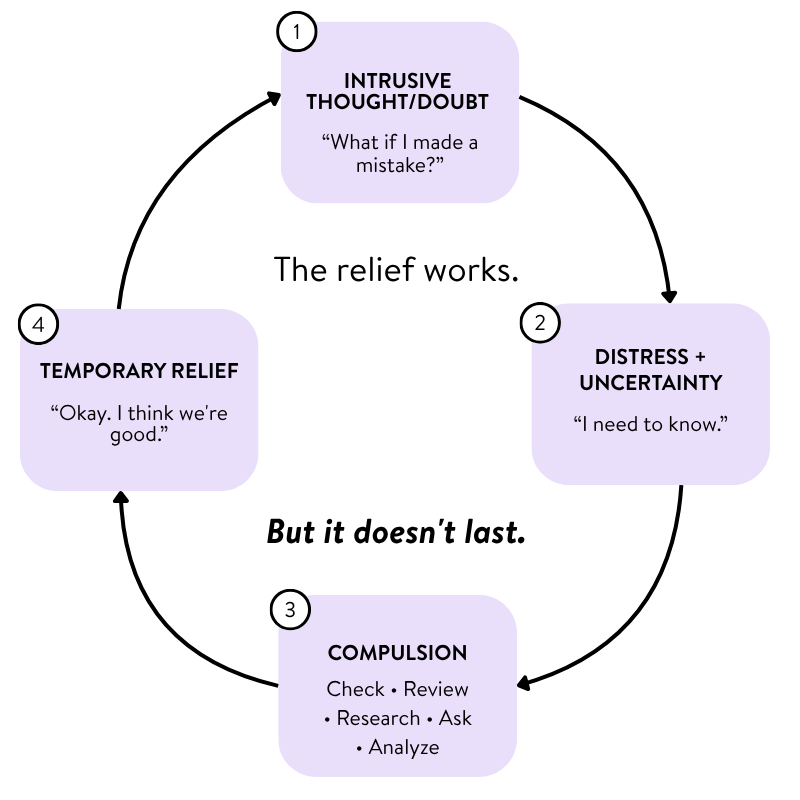
One of the biggest misconceptions about OCD is that it’s defined by having unusual or intrusive thoughts.
But intrusive thoughts happen to pretty much everyone.
A random thought like:
What if I left the stove on?
isn’t necessarily OCD. What’s more important is what happens next. For someone caught in an OCD cycle, the thought can create a sense that something needs to be done about it.
The cycle might look like:
Intrusive thought, image, urge, sensation, or doubt
↓
Distress or uncertainty
↓
Compulsion
↓
Temporary relief
↓
The doubt returns
For example:
“What if I left the stove on?”
→ anxiety
→ go back and check
→ Okay. It’s off.
→ relief
→ …but did I check the right burner?
So you check again.
The tricky part is that checking works, at least temporarily. It reduces the discomfort. But that relief can teach the brain that the intrusive thought was important and that checking was necessary to feel safe again. Then the next time doubt appears, the urge to respond can become even harder to ignore.
Compulsions Aren’t Always Visible
When people picture OCD, they often imagine behaviors like handwashing, counting, arranging, or checking locks. But compulsions can happen entirely inside someone’s head.
They might include mentally replaying a conversation, reviewing a memory, analyzing whether you had the “right” intention, checking how you feel about something, trying to prove a thought isn’t true, or repeatedly asking yourself the same question from slightly different angles.
Reassurance seeking and repeated researching can also become part of the cycle. That’s why someone can have significant OCD symptoms without anyone around them realizing they’re performing compulsions.
The question isn’t just “Do I do this repeatedly?”
A more useful question is:
“What happens if I don’t?”
If resisting the behavior creates increasing distress, uncertainty, a sense of incompleteness, or pressure to go back and “make sure,” that’s important information. And if doing it creates relief, but the relief doesn’t last, that pattern is important too.
That’s the cycle we’re looking for.
What If You Have ADHD and OCD?
So far, we’ve separated ADHD and OCD to make the differences easier to see.
Real life isn’t always that tidy.
You can have both.
And sometimes ADHD creates exactly the kind of uncertainty that OCD loves to grab onto.
You might genuinely forget whether you locked the door, miss an important detail, lose something, or have trouble remembering exactly what happened because your attention was somewhere else.
Then obsessive doubt enters the conversation:
ADHD: “I genuinely don’t remember if I did that.”
OCD: “…you DON’T KNOW?”
ADHD: “Nope.”
OCD: “Cool. We should probably think about this for the next four hours.”
OCD can also make ADHD-related difficulties harder to manage.
A simple email can become:
Remember to respond → figure out what to say → write it → reread it → worry about how it sounds → rewrite it → check again → decide not to send it yet → forget about it entirely.
So sometimes the answer to “Is this ADHD or OCD?” really is:
Both may be contributing.
So How Do You Actually Tell the Difference?
There isn’t one behavior that cleanly separates ADHD from OCD.
A clinician looks at the pattern around the behavior, including things like:
✦ what tends to happen immediately before it
✦ what thoughts, emotions, sensations, or urges are present
✦ what the behavior seems to accomplish
✦ what happens when you try not to do it
✦ whether it provides temporary relief
✦ whether intrusive thoughts or obsessive doubts are involved
✦ your developmental history and when different patterns began
✦ how attention and executive functioning show up across different areas of your life
For example, “I check things repeatedly” doesn’t tell us nearly as much as:
“I check because I genuinely don’t remember doing it.” or: “I remember doing it, but I can’t convince myself that it’s safe to stop checking.” That’s why good differential assessment isn’t simply matching behaviors to diagnoses.
It’s understanding what’s happening before, during, and after them.
Could Something Else Be Part of the Picture?
ADHD and OCD aren’t the only things that can involve overthinking, avoidance, perfectionism, repetitive behaviors, difficulty with uncertainty, or getting stuck.Anxiety, autism, trauma, depression, chronic stress, and other experiences can create overlapping patterns too.
And sometimes several things are happening at once.
An autistic person’s reliance on routine, for example, isn’t automatically an OCD compulsion. Someone with ADHD may develop significant anxiety after years of forgetting important things or making mistakes. Trauma can affect how someone responds to perceived danger or uncertainty.
This is another reason context matters. The goal isn’t to find one label that explains every behavior you’ve ever had. It’s to find an explanation that makes sense of the larger pattern.
When “Which One Is It?” Isn’t the Most Useful Question
If you’ve been Googling OCD vs ADHD, ADHD or OCD, or increasingly specific versions of the same question, you’re probably hoping to find the symptom that finally settles it.
Sometimes a more useful question is:
What is my brain trying to accomplish when this happens?
Is it trying to compensate for something you don’t remember? Get enough stimulation to engage? Avoid something overwhelming? Reduce anxiety? Neutralize an intrusive thought? Prevent a feared outcome? Reach certainty? Make something finally feel “right”?
There may be more than one answer. Understanding what’s underneath the behavior can give you something more useful than a label alone: a clearer idea of what kind of support might actually help.
Understanding Before Labels
If you’ve spent years bouncing between: “Maybe it’s ADHD.”
“Maybe it’s anxiety.”
“Wait…could this be OCD?”
and “Maybe I’m just overthinking everything.” you don’t necessarily need another online checklist. You may need help putting the pieces together. At Nonlinear Minds Therapy, assessment focuses on understanding the patterns underneath your experiences, not simply counting symptoms. Because sometimes the most helpful outcome isn’t only:
“You meet criteria for X.”
It’s:
“Oh. This finally makes sense.”